Tag: #ds106

  • Shiver’s Journey Through Three Lands

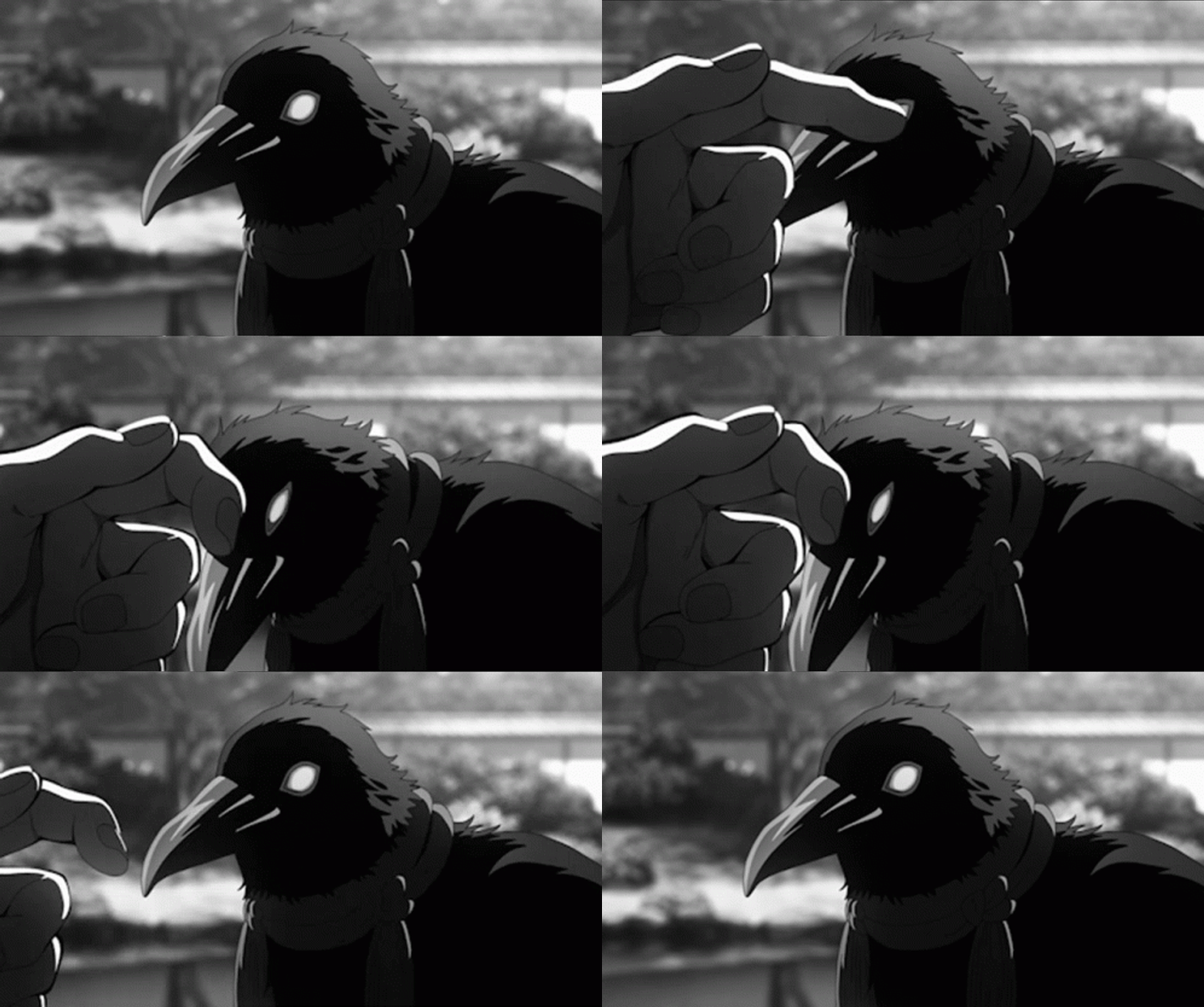
    Once upon a time, in a city where cars drive and streetlights hummed all night, there lived a tiny crow named Shiver. His feathers were blacker than wet asphalt (it’s pretty dark) and his eyes glistened under the streetlamp’s light. Shiver was no ordinary crow. While his siblings fought over bread crumbs and potato chip bags, Shiver spent his days hopping from alley to alley searching for treasures. Not just treasures like golden coins or necklaces (though he’d happily take those too) but anything shiny that caught light. Sometimes it was a soda can tab that sparkled brightly with contrast against the concrete. Other times it was a shiny candy wrapper. Shiver kept each treasure tucked away under the old stone bridge he called home, a little place lined with foliage and dried grass where cars rumbled over the bridge and the rain water gently streaming below. Each shiny thing he found made his chest flutter with pride!

    One morning, everything changed.

    Shiver was hopping along the sidewalk, avoiding shoes stepping on him and vehicles when he saw something that made him pause midway. There! Stuck between the cracks of the sidewalk, there was a glowing silver pendant. Its glow was so soft, not bright like the usual treasures but warm. Shiver blinked. Once. Twice. His tiny heart thumped hard. He rushed over and pried it free with his beak. He expected to feel that usual spark of joy he felt with every treasure he found. But instead… a heaviness sank into his chest. It felt like… sadness? Why? A longing for something he couldn’t name. For the first time, Shiver felt that this treasure wasn’t his to keep. So he wore it around his neck, preened his black feathers, and got ready to set off. He didn’t know where he was going. He just knew that… he needed to find whoever lost this glowing thing. Because if it made his chest feel heavy, it must make the person who lost it feel even heavier.

    First, The Forest Biome

    Shiver flew beyond the city’s rooftops, leaving behind honking cars and blinking traffic lights. Soon, pine needles brushed his wings and fog rose around his tiny body. The forest felt mystical, filled with whispers only trees knew (it’s the sound of wind brushing through the tree branches, I just wanted to word it fancy for style points). As he glided between thick trunks, his eyes caught something small and silver half buried in the moss. A silver button, contrasting among the green foliage. He swooped down, picked it up with his claws, and felt a pang in his chest. It was another emptiness he didn’t understand. Whoever lost this button… missed it. Deeply. Maybe it fell from someone’s coat on a boy scout mission. Shiver tucked it into his feathers. He felt a bit heavy but his heart felt a bit more fulfilled. Well, he fluttered on. Before he left the forest, he happened to find a thick piece of paper caught in some branch. It appears to be some sort of promotional film poster. It looked oddly familiar to him. He didn’t think much of it and moved on.

    Shiver's Promotional Poster
    Link to process if interested

    Second, The Ice Biome

    He flew north. The trees started to thin out and snowflakes clung to his feathers. The world turned silent and white and stretched endlessly under the white sky. He soared over frozen lakes that gleamed like mirrors, his wings echoing across this vast emptiness. As he flew, something bright red caught his eye, standing out boldly against the white snow below. Curious, he swooped down and landed softly near it. Peeking out from under the snow was a small folded card decorated with hearts. He pecked at it until it slid free from the icy grip.

    On the front was a little image of… a crow? Its feathers were black and it had wide eyes just like his.

    Shiver Valentine Card
    There are some puns here.

    Shiver blinked. Once. Twice. The card felt oddly familiar though he couldn’t place his feathery fingers as to why. Maybe it was because a shiny silver pen was used to write the words or maybe it was just the way the little crow drawing looked so proud and clueless. He tilted his head, shrugged his wings, and tucked the card into his wings along with the button. His body was growing even heavier with these lost memories but he kept flying north through the chilling winds, wondering what “Shiver” meant to whoever made that strange red card.

    Third, The Lava Biome

    Finally, Shiver reached the blazing red mountains where smoke rose upward into a sky suffocated in orange with heat. Molten rivers bubbled and hissed below like angry fireballs from Super Mario, trapped underground. Shiver landed on a cooled black rock, the heat radiating through the cracks and reaching his tiny claws. There! Glimmering under ash and soot laid a cracked ruby marble. The glow was pulsing weakly. When Shiver picked it up, sadness seeped through his feathers. Deep and old sadness… like forgotten dreams of someone who once held it tightly before letting it slip away. Maybe it was won in a childhood game. Maybe it fell from a pocket on the way home. But how did it reach the lava biome? Well, he told us to not think too much about it. Shiver tucked it into his feathers along with the others. His small body felt heavy under the weight of these treasures.

    Lava Warning Poster
    For some reason, SoundCloud said this audio had “copyright”. I don’t know where. YouTube allowed it so I reuploaded the audio in this video format instead.

    The Old Town Street

    At last, as the sky turned gold and purple in the evening, Shiver reached a quiet old street on the city’s edge. Small brick buildings lined both sides with their windows glowing softly with lamplight. Some were tiny shops with handwritten signs, others were narrow homes stacked close together with flower pots on their balconies. Electric powerlines crisscrossed the sky.

    oldTownRoad
    (imagine it’s night time)

    Shiver fluttered down and perched lightly on one of the power lines, his claws gripping the cable as it hummed softly beneath him. Below, people walked home with tired expressions, stuck in their busy thoughts. He scanned every face, hoping and hoping that someone would pause and look up, then say “That’s mine” as they saw the pendant around his neck.

    But no one did.

    The sky deepened in dark color as shopkeepers closed their shutters and turned their signs to “Closed.” A delivery bike rode past, a stray cat stretched its body under a parked car, distant train noises ran beyond the buildings. He knew he might never find who the pendant belonged to. But as he closed his eyes for a moment, he felt peace settle into his chest. Because along the way, he discovered something he’d never known. These treasures were not just shiny things. They were pieces of someone’s life which carried stories he would never hear but could still feel. He opened his eyes, looked at the glowing pendant one last time, then lifted his wings and took off into the sky. As he soared above the shops and rows of rooftops, he didn’t feel sad anymore. Even if some questions never find answers, he realized the journey itself is what makes life feel full for him.

    Final Weekly Summary

    At first, I honestly didn’t know what to expect from this class. I thought it was just going to be writing short stories and posting them, but as soon as we had to make audio and video projects, I realized digital storytelling is a lot more layered than that. I learned that storytelling isn’t only about what words you choose but about how you present those words through sound, visuals, design, and pacing. This prepares you to become an effective online storyteller, blogger, influencer, you name it. This course really puts the “digital” in “storytelling”. I think the audio assignments were the most surprising for me. Before this class, I always thought sound was just background filler to keep videos or games from feeling empty. But after learning about War of the Worlds and The Moth stories, I realized sound itself can be the story. It carries emotion and builds suspense even if there’s nothing to see. The Rough Morning assignment was honestly fun to play and experiment with. With the idea of a rough morning, layering all the sound effects like the alarm, the rustling, the fall and crashing nose… it felt like making a comedic scene for a movie. The Calling Totoro audio was a really calming process. It was a nice contrast to the panicked sounds of the previous assignment. I spent time carefully picking and layering peaceful forest noises, acorns dropping, quiet rain, and flowing streams. It felt relaxing. Totoro might actually appear. The design assignments felt the most enjoyable overall. Reading The Vignelli Canon made me realize that good design is really about asking what’s appropriate for what you’re trying to say and not just decorating for the sake of it. Small choices like typography, color, or what to leave out completely change how someone feels when they see it. But even though I got the idea, actually implementing it in such a short time proved to be a challenge. One part that surprised me was how even everyday things like a cereal box or a watering can are designed with so much intention as the DesignBlitz really opened my eyes to that. Making the One Memory in Color photo was absolutely my favorite piece. It felt good seeing how a simple edit like just leaving one apple and a butterfly bright while the rest faded led me come up with something deeper about how memories work. It was one of the first times I’ve ever altered a photo like that, and this assignment made me pretty proud. Some of the playful edits were fun too. The Valentine’s Day card for Shiver was silly but made me see how even a simple card has to balance humor and clarity if you want it to feel right. The Lion King Paid Escort was trickier. I had to figure out how to make the joke land without losing the darker meaning behind Scar’s betrayal. If anything drove me crazy, it was copyright. Finding a replacement for my original pigeon image (I really want to share it…) after learning I couldn’t use it wasted so much time but it taught me a real lesson about checking licenses early. Copyright was definitely quite a hassle with this class.

    If I had to take this class again, I’d manage my time better, especially with copyrighted material. Next time, I shouldn’t be taking four summer classes in the same semester. I spent so many extra hours searching for replacement images or sounds because I didn’t check licenses early on. I’d make sure to confirm usage rights before starting an edit so I wouldn’t waste time redoing things. I’d also try to plan my assignments earlier in the week instead of pushing them closer to the deadline to do other assignments form other courses. That way, I’d have more space to experiment with my ideas instead of rushing to finish just to submit on time. My favorite project was definitely this final story about Shiver. I enjoyed expanding the lore for Shiver and putting everything together into one narrative, adding each media piece like a puzzle piece revealing more about his journey. Even though the ending is open-ended, I feel it’s still the most meaningful story I’ve made. I’m glad Shiver got to explore three biomes, picking up some lost memories along the way and still carry his pendant home under the sunset. Overall, this class turned out to be one of the most creative courses I’ve taken so far. I never expected myself to be this imaginative before. Each module pushed me to think in different ways, whether it was creating sounds to tell a story, designing images with meaning, or bringing a character’s world to life through writing and video. It made me realize that digital storytelling isn’t just about editing skills or fancy tools. It’s about finding ways to express ideas that I didn’t even know I had inside me. That’s something I’ll carry with me for a long time.

    Digital Assignments

    (2) Draw it. – Assignment Bank

    (3.5) Promotional Flyer – Assignment Bank

    (4) Valentine – Assignment Bank

    (2.5) Create a Warning Poster – Assignment Bank

    (3) Sound Effects Story – Assignment Bank

    (4) Where do you want to go? – Assignment Bank

    (2) Find Your Dream House – Assignment Bank

  • Daily Creates Week #5

    This is my Daily Creates for Week #5.


    07/21/2025

    #tdc4938 #ds106 From Where You Sit, Make a Found Poem | The DS106 Daily Create

    Find a “found poem”. I found this on the back of my book.

    All over the world,
    The bad news
    Make a difference.

    foundPoem

    #tdc4938


    07/22/2025

    #tdc4939 #ds106 Reflecting in a Photo | The DS106 Daily Create

    Post a reflection. What can you see?

    ornamentReflection

    #tdc4939


    07/24/2025

    #tdc4941 #ds106 The Big World from Down Here | The DS106 Daily Create

    Show something made larger.

    guitarClose

    #tdc4941

  • Intro Video Summary

    What Did I Learn?

    This week felt long but in a good way. I learned a lot about film and storytelling but also about myself. When I started Part II, reading Roger Ebert’s “How to Read a Movie,” I didn’t think just pausing a single frame would teach me anything. But it did. It showed me that directors place things intentionally like shadows or where someone stands in a scene and it all guides how we feel without us even realizing it. I think I liked his method because it forces me to slow down and actually see what’s in front of me instead of letting it pass by me so quickly. But I can also see why it might ruin the experience for some people if they’re just trying to enjoy the movie in the moment. Watching the two videos about cinema techniques opened my eyes more. “Hitchcock loves Bikinis” was simple but effective which shows how switching just one clip can change how an audience views a character. And “Tarantino // From Below” taught me how a low angle can make someone look powerful, even if they’re not doing anything in particular. Overall, I learned that videos and movies use camera angles, editing, and sound to make us feel something without us even realizing why.

    In Part III, I watched the “Women” scene from Scent of a Woman in three different ways. When I muted the sound, I noticed how camera angles made Al Pacino’s character feel calm but dominant. When I only listened, I realized his rough but steady voice sounded poetic. Watching it all together made everything fit. His slight smirk and soft hand movements made his words feel deeper. Doing this showed me how visuals and audio blend together to build meaning. I never really tried analyzing a video in this manner before.

    What Was Harder Than I Thought?

    The hardest part was having the patience to use Adobe Premiere Pro for the first time. Before, I used a much more simpler editing software called Wondershare Filmora. Editing felt overwhelming because there were so many buttons, panels, and timelines. Just figuring out how to cut and layer clips properly in Premiere Pro took longer than I expected. I thought I could learn it quickly but there were moments where I spent hours just trying to figure out why something wouldn’t export the way I wanted.

    What Was Easier Than I Thought?

    Writing and animating Shiver’s story was easier than I thought. Usually I overthink storytelling, but for some reason, writing his adventures felt natural. It was calming to imagine him finding treasures or dreaming about Japan. Animating him felt fun too and I didn’t want to stress myself too hard on making it look too professional, like I was bringing to life a small part of my own quiet thoughts.

    What Drove Me Crazy?

    Editing the 10 tips video drove me crazy. The final video turned out very choppy. I spent so long trying to make it smoother and better quality in Premiere Pro but no matter how many settings I changed, it never came out the way I imagined. It was frustrating because I wanted it to feel smooth like the others but instead it felt kind of awkward to watch.

    What Did I Enjoy?

    I enjoyed bringing Shiver to life. Making his story was pretty relaxing and felt peaceful. Writing his Japan dreams felt like I was traveling with him. Even though editing drove me crazy, I still enjoyed seeing Shiver come alive as a character who quietly observes the world, finding beauty in small simple things.

    Links

    Part II
    Some Techniques in Film – Typing to Myself

    Part III
    Film Techniques in “Scent of a Woman” – Typing to Myself

    Part IV
    Shiver: The Little Crow’s Treasure – Typing to Myself
    Meet Shiver, The Little Crow Who Dreamed of Japan – Typing to Myself
    Shiver’s 10 Tips Before Visiting Japan – Typing to Myself

  • Shiver’s 10 Tips Before Visiting Japan

    Meet Shiver, a little black crow with bright curious eyes and a brave heart. He spends his days flying above cities and rivers, always searching for shiny treasures. But lately, Shiver has been dreaming of going somewhere far away. Somewhere calm, beautiful, and filled with wonders… like Japan.

    Shiver is looking around

    He imagines soaring over Japan’s green mountains and bright city lights. Hearing the gentle hum of train stations, the quiet sounds of chopsticks in small diners and the rustling of trees near old shrines… If he could go, these are the 10 things he’d want to remember.

    1. With appointments, BE ON TIME. Japanese people are strict with time, so do not keep the other person waiting. If the bus or train is late for five minutes, there will be a huge fuss.
    Shiver thought, “Five minutes late? I’d better flap my wings faster next time.”

    2. With Japanese dining etiquette, there are many dining manners, but saying “itadakimasu” (before eating) and “gochisosamadeshita” (after eating) are the most typical. This is to show appreciation to the food we have on our plate.
    Shiver chirped, “I always caw before pecking my crumbs too. Same thing, right?”

    3. Cars drive on the left side of the road instead of on the right, so foreigners should be careful as this might catch them off-guard.
    Shiver tilted his head, “Left side, right side… good thing I just fly over it all.”

    4. Most things are sold in different units than in America, so it’s a good idea to get an app so you can calculate things quickly before you come. In America, vegetables and fruits are often sold by weight, right? In Japan, most things are priced by the piece.
    Shiver blinked, “I hope worms are sold by the piece too… I’d pick the fattest one.”

    5. There is no service such as buy two and get one free.
    Shiver ruffled his feathers, “No free worms? That’s disappointing.”

    6. Think of a large drink at McDonald’s or Starbucks in Japan as a small or medium drink in America.
    Shiver nodded, “That’s okay. I’d probably just spill it anyway.”

    7. Tipping is rarely done in Japan. You don’t have to pay a tip when you eat out. However, if you go to a ryokan (Japanese inn), you might have to pay a small tip.
    Shiver cawed softly, “No tipping? Great. I don’t even have pockets.”

    8. There is no yard sale or garage sale in Japan. There is no sale of lemonade.In Japan, there is a strict view on privately selling things. Although there are websites for private sales, they are strictly controlled. Flea markets organized by towns and cities are also strictly monitored.
    Shiver sighed, “So no shiny spoon sales on the sidewalk… darn.”

    9. The act of bowing down. For temples and shrines? That’s a big part of Japan, but not just for temples and shrines. Japanese people bow when expressing gratitude, apologizing, or greeting others. The depth of the bow also has meaning. When apologizing, bow deeply.
    Shiver tried bowing, “I hope my little crow bow is respectful enough.”

    10. Dogeza (土下座) is considered the highest and most extreme form of bowing in Japanese culture, used to show deep apology, utter remorse, or desperate pleading. This is Japanese etiquette which involves kneeling directly on the ground and bowing to prostrate oneself while touching one’s head to the floor
    Shiver puffed up, “I’d probably just flop over trying that one.”

    The Dogeza meme in Japan

    Media
    gif-animation-cherry-blossom-branch-flowers.gif (500×250)
    Japan, Cherry Blossom, Sakura. Free Stock Video – Pixabay
    Anime, Colorful, Seamless. Free Stock Video – Pixabay
    Clothing, Boutique, Shopping. Free Stock Video – Pixabay
    Lunch, Meal, People. Free Stock Video – Pixabay
    Temple, Pond, Garden. Free Stock Video – Pixabay
    Market, Fair, Sale. Free Stock Video – Pixabay
    Samurai ☯ Japanese Lofi HipHop Mix
    (22) Japanese monk at Nikko Temple sounding a bell – YouTube

  • Meet Shiver, The Little Crow Who Dreamed of Japan

    Shiver is a small black crow with bright curious eyes. He spends most of his days under an old stone bridge in the city, collecting shiny treasures and listening to the river water flow. But lately, Shiver has been dreaming of a place far away, to a place called Japan. He’s never flown that far before, but in his little heart, he imagines what it would be like to wander through quiet streets, cozy diners, and peaceful hot springs.

    Shiver is Flying
    Shiver is flying to Japan!?

    One place Shiver really wants to visit is a small Japanese diner. Not like the American diners with huge booths, clinking forks, and syrup-covered pancakes he sees through windows in the city. Shiver imagines tiny cozy Japanese diners with wooden counters and just a few seats lined up, kind of like those family-run sushi places. He pictures an old chef quietly frying up fresh fish, the smell of miso soup floating through the warm air, and steam floating up around the lights. It feels personal to Shiver. Like it’s not just a place to eat but a place to feel safe, warm, and at home.

    mapOfTakagakiNoSushi
    Map to Takagaki No Sushi, Tokyo

    Another place Shiver wants to see is their small train stations. Now for a crow who flies everywhere, it seems funny to want to sit at a station waiting for a train. But to Shiver, it sounds peaceful. Not like the busy echoey stations in America, but those quiet little stations he sees in dramas, with wooden benches, vending machines humming softly, and maybe a gentle breeze blowing through as the sun sets behind the tracks. He thinks it would be nice to perch on a rail, watching the trains roll by and seeing people come and go, carrying stories he’ll never know.

    Then there are the onsen hot springs. Shiver has never even seen a hot spring before. The idea of sitting in naturally warm water outside, surrounded by mountains and trees with steam rising into the cold air, feels peaceful. He imagines closing his eyes, feathers puffed up in the warm steam, letting his small body rest. Huh? Shiver can’t go in an onsen?

    And of course, cat cafes. Shiver thinks it would be funny to see humans sipping coffee while fluffy cats roam around their tables. He’s heard you’re not supposed to approach the cats but rather let them come to you. That sounds like something a crow could understand. He thinks it would be a cozy place where time slows down and everyone forgets about the busy world outside.

    In the end, Shiver knows he might never really fly to Japan, but just dreaming about these little places fills him with hope. He realizes it’s not always the big flashy spots that make a place special. Sometimes, it’s the cozy diners, clean subways, hot springs, and quiet cafes that makes living in this world a little more softer.

    This is from the cartoon Chiikawa which is native to Japan.

    Sources
    Takagaki no Sushi | Restaurant Reservation Service in Japan
    Photo for Izakaya Nana
    Hikyō station – Wikipedia
    https://www.japan.travel/national-parks/plan-your-visit/guides-and-stories/guide-hot-springs-japans-national-parks/
    Fashionable cat café / MONTA
    Traditional Japanese Music – E. music ▪ [No Copyright Music]

  • Shiver: The Little Crow’s Treasure

    Meet Shiver, a small black crow with bright curious eyes. He spends his days searching for shiny treasures around the city. Though he may be small and often overlooked, Shiver carries a brave little heart inside his feathery chest. Every glimmer he sees fills him with excitement.

    Shiver

    Shiver lives in the bustling city, deep under an old stone bridge where cars rumble above and river water flows quietly below. If you listen closely, you can hear the car honks, people talking from far away, and the soothing rush of water under the bridge and rain.

    Here is my short video story about Shiver. This was my first time editing in Adobe Premiere Pro so it’s quite simple and awkward, but I enjoyed learning how to cut clips, add titles, and layer audio.

    Shiver: The Little Crow’s Treasure by myself

    For the Tell Your Character’s Story, Shiver finds a glowing silver pendant stuck in the sidewalk. He works hard to pull it out and proudly brings it home. But at night, the pendant’s glow reveals a hidden photo of a smiling little girl. Shiver feels something he never felt before… he realizes that some treasures belong to others and hold special meaning. By morning, he decides to fly off and return it to whoever lost her.

    Sources

  • Film Techniques in “Scent of a Woman”

    Watching the scene, “Women” from Scent of a Woman, without audio, I noticed how close the camera stays to Al Pacino’s face. It switches to the young man’s face a few times but mostly it lingers on Pacino, capturing every wrinkle (especially the forehead), movement and shake, and subtle facial expression. The lighting is warm and natural, shining on the left side of his face softly while the right side has a slight shadow, adding a sense of depth and realism.

    Al Pacino
    Snapshot from the scene “Women” in Scent of a Woman. I took notice of the lighting on his face.

    I’m not sure if this was intentional, but the camera angle felt slightly below eye level when focusing on Pacino which made him appear larger and more dominant, giving his character a seemingly confident personality, almost like he’s a teacher lecturing the world about women. When it cuts to the young man, the camera is at his eye level or rather, trying to be above? The young man’s head was mostly tilting down most of the time, making him look smaller and more passive, like a quiet student listening to a teacher. Overall, there are only a few cuts between these two characters which keeps the focus tight and intimate. It felt like the camera wanted us to stay with Pacino’s words and expressions rather than get distracted by anything else.

    The Young Man

    Listening without watching, Al Pacino’s voice felt rough and deep yet it had a calm tone to it, showing both his age, wisdom, and rough life experience. He speaks at a steady pace with short pauses, especially before words like “tits” or “legs” which added emphasis and drew the listener in. The way he speaks and his phrasing sound almost poetic… like he is reciting a love poem rather than casual talk. It makes for a strange love poem but somehow it fits him. There’s no background music in this scene, just purely dialogue with that slight ambient background plane noise which added realism and more focus to his words. You can hear slight movements like shifting in the seat and the glass he’s holding and even fabric creasing as he moves which enhances the scene without being too distracting. The younger man doesn’t have any lines here and this audio isolation made me realize how Pacino dominated this conversation with just his words, tone, and pauses.

    Watching it fully with both visuals and audio combined, I noticed how Al Pacino’s words and expressions fit together so perfectly. Before, when I only listened to it, I thought he sounded calm and poetic but then seeing his facial expressions at the same time made it even clearer how serious but also slightly playful he is. When he talks about hair, lips, breasts, and legs, he doesn’t say it with an awkward laugh or anything. Instead, his face looks calm and thoughtful almost like he’s reciting a memory or something sacred to him. I haven’t watched this movie before, but that’s the sort of vibe I’m taking from this scene. His eyes don’t seem like they are focused on anything specific, more like just following where his head turns, and when he turns his head slightly, it makes his words feel more dramatic since his attention and thoughts are on his words. His small smirk when he says “passport to heaven” adds a sense of humor but also confidence like he knows exactly what he’s saying and doesn’t care what others think. One thing I noticed that I didn’t see before was how he uses his hands while talking, only ever so briefly, but it does appear. He slightly moves his glass and gestures gently as if he’s trying to paint something or convey something through the air with his words. When he says “Are you listening to me, son?” he leans in just a bit, making it feel more personal like he’s trying to pass down wisdom from his own life experiences. The younger man just sits there quietly and seeing his face while listening to Pacino makes it feel like he’s absorbing every single word. He barely moves and his slightly lowered head adds to the feeling that he is a student and Pacino is the teacher. I also noticed how the camera barely cuts away from Pacino when he’s speaking these lines. The focus stays tight on him, showing his emotions with every slight eyebrow raise or mouth twitch. The few cuts to the younger man almost felt like reminders to the audience that someone else is there but he doesn’t really hold the power in this moment. Pacino does. The lighting makes Pacino’s face look warm and a bit tired which I think matches his rough voice and shows his age and life experience. Another thing I realized while watching it with both senses was the pacing. The pauses between his words felt longer when watching and listening together. His breathing, the small seat noises, and the sound of the glass moving create a realism that made me feel like I was sitting right across from him. 

    Ebert talks about “intrinsic weighting” and how placement can create its own meaning. Pacino is on the right side, giving him a more powerful and dominant feeling while the young man is on the left, making him look less powerful. The low angle on Pacino enhances him which makes him appear strong and confident while the straight eye-level or high angle on the young man makes him look like he’s listening and learning. Ebert said movement to the right seems more favorable, but even though they aren’t moving here, Pacino’s placement still gives him that sense of power and strong calm. Watching it with one sense muted each time showed me how camera placement, angles, and sound work together to build a character’s presence. Without sound, I noticed the angles. Without visuals, I noticed the power in his pacing. Together, it creates a scene that feels deep and confident just like his character.

  • Some Techniques in Film

    I read Roger Ebert’s “How to Read a Movie” and it showed me how to look at movies differently. I never really thought about how just pausing a movie could show you so much. He talked about how his students would call out “stop” during a movie and they’d all sit there and think about that one frame, kind of like how sports teams analyze a game frame by frame to find out what went right or wrong. I think this method works because it gives you time to actually see the details you’d normally miss when everything is moving so fast. You notice the little details like the shadows, where people stand, and how their eyes look, as those small things can tell you what a character is feeling or thinking without them saying anything. But I think this method might not always work for everyone because some people just want to feel the movie as it flows instead of stopping it all the time. For them, it might ruin the emotional build up of a scene. Well, normally you’d watch a film without pausing first before rewatching it to make your analysis. He also talked about how people on the right side of the screen feel more positive while people on the left side feel more negative. This seemed like a really foreign concept to me because I never noticed it before but I can see why it works. The connection I could make is that we read things left to right so when someone moves to the right it feels like progress or hope. If they move to the left it feels like going back or something sad. But I also feel like this might not always work depending on what culture you’re in. Like if you grew up reading right to left (the Arabic language for example) maybe it feels different. Still, it’s fascinating how directors use these small techniques to essentially guide how we feel about a scene without us even noticing we’re feeling this way because of it.

    The two videos I watched taught me different cinema techniques. One of the videos I watched was “Hitchcock loves Bikinis.” I liked how simple it was but still made a big point. Basically, the video showed how putting two clips together can completely change how you see someone. Like when shown man looking at a mother with a baby, then back at him smiling, you think he’s a nice old man. But when the middle clip was changed to a girl in a bikini, suddenly he’s dirty. With the power of editing using cinematographic techniques, it can change what an audience thinks about a character without changing anything about the character themselves. I think that’s something fun to see when I’m trying to use it in my own projects. Just experimenting with seeing how switching out just a single clip can make a whole different meaning in filmmaking.

    Another video I watched was “Tarantino // From Below.” It showed so many scenes where Tarantino filmed his characters from below looking up at them. It made them look super powerful and intimidating. Just seeing how from this perspective, it makes the viewer feel small compared to the character. Like the character is towering over you and it gives them that strong, dominant vibe. I think these techniques matter because it shows how movies aren’t just about telling stories with words and the props that are physically there, but also it’s about making the viewers FEEL something just by how you place a camera or what clips you decide to put together. Overall, I learned that reading movies is about looking deeper and seeing the choices that directors make to essentially guide your emotions without you even noticing.

  • Daily Creates Week #4

    This is my Daily Creates for Week #4.


    07/14/2025

    #tdc4931 Book Spine Story | The DS106 Daily Create

    Create a poem using words from the spine of books.

    Listen to Yourself [and] Think Everything Over
    Fear [is] What She Does Next [that] Will Astound You
    [Because] The Best Kind Of People [hold] Three Sides Of A Heart
    [We are all] The Perfectionists [chasing] A Force So Swift

    bookSpinePoem

    #tdc4931


    07/16/2025

    #tdc4933 #ds106 Muppets | The DS106 Daily Create

    Envision yourself as a Muppet.

    muppet

    It seems if I were a Muppet, I would have a little floating Muppet companion. I like its attention to detail on the hoodie!

    #tdc4933


    07/18/2025

    #tdc4935 #ds106 Handwritten | The DS106 Daily Create

    Create a hand-written poem.

    pinkGiraffePoem

    #tdc4935

  • Intro Sound Summary

    What Did I Learn?

    This week taught me how the audio aspect of storytelling can make a listener feel something real, even if there’s nothing to see. I used to think sound was just background. Like filler to make videos or games less empty. But listening to the Ira Glass’s advice and War of the Worlds broadcast and The Moth, I started to realize that sound itself is the story sometimes. It carries emotion and builds suspense. For example, in War of the Worlds, they didn’t need alien visuals to scare people. The newscast format and the compelling voices and background noises made people believe it was really happening right outside their homes. Ira Glass said that everything you record is “trying to be crap” unless you’re intentional with it, and I think War of the Worlds showed that by how intentional they were with each sound and pacing choice. I’ve learned that simplicity is not a weakness in auditory storytelling. When I listened to Mahmoud Banki’s story on The Moth, there were no fancy background tracks or heavy edits, none of that. Just his voice and pauses carried the story. The silent moments spoke louder than any dramatic music could have. I’ve seen all these bright and loud edits on YouTube, but this is different from that. It makes me think of how I’d want to  approach sound in my own work. Sometimes it’s not about layering as many effects as possible. It’s about choosing the right sound techniques that can hold meaning and “breathe”.

    About my rainy walk to class? That morning felt different. I woke up to the quiet tapping of rain on my window and didn’t really want to get up, but I had class at eight. As I walked outside, I noticed how empty and calm the campus felt. The rain made everything smell fresh and the only sounds were my footsteps, the slight rain, and the water fountain I walked past. Recreating that with layered rain, fountain noises, footsteps, and the faint car felt satisfying because it captured that calm and tired but peaceful feeling. The Totoro Nature Whistle was another piece that surprised me. I thought stacking four natural sounds together would sound messy, but it turned out peaceful. I layered the acorn drops first, then rain pattering leaves, a gentle forest stream, and finally wind brushing through cedar branches. When I listened back, I imagined Totoro standing under the trees. This audio didn’t need editing because they already carry the quiet beauty by themselves.

    What was harder than I thought?

    Finding the right sounds was harder than I imagined. I thought it would be easy. Like search “rain” on freesound.org, download it, done. But not every rain sound feels the same. Some were too harsh and others too muffled. When working on Totoro’s Nature Whistle, I spent almost an hour sampling different rain and forest water streams and wind sounds until I found ones that felt calm and natural enough to fit Totoro’s world. Also, getting the timing and volumes to blend in Audacity took a lot of trial and error. Especially for the sleeping panic story, The Rough Morning. If the footsteps or blanket rustling came in even half a second too late, the whole illusion broke.

    What was Easier?

    I think the easiest part was listening to the audio stories and analyzing them. Whether it was Ira Glass’s talks,War of the Worlds, or the story from The Moth, I didn’t struggle to pick out what techniques were used or why they were effective. I guess it’s because I naturally pay attention to details in how people tell stories, their pacing, and certain sounds used to shape the atmosphere. It felt straightforward to write down my thoughts on them. Also, writing the reflections for each audio creation came easier than I thought it would. I assumed I’d have nothing to say about simple sounds like rain or rustling fabric, but words just came to me. Listening carefully made it easier to find meaning or memories behind the sounds. All I had to do was describe how I felt.

    What Drove Me Crazy?

    Honestly, Audacity itself drove me a bit crazy. Every time I imported a clip, the tracks would rearrange and I’d lose track of where my selections were. Adjusting volume levels felt endless. I’d fix the rain only to find out the acorn drop was suddenly too loud, then lower that and realize the wind was gone. It felt like trying to juggle four balls. Also, Freesound’s catalog didn’t have too many options for Creative Common 0 pieces which made finding the right clip take longer than expected. I think I spent more time searching for sounds than actually editing them.

    What Did I Enjoy?

    I think the part I enjoyed the most was just listening. Like, really listening. Not just hearing something in the background while I do homework. I sat down with my headphones on and paid attention to every small detail in the sounds I was working with. For example, when I was making Totoro’s Nature Whistle, I spent a while listening to each layer by itself. The rain falling on leaves, the water stream running through rocks, the faint rustling of trees, and the sound of acorns hitting the ground. I initially imported them on top of each other at the same time, and you could maybe hear all four of them, but that might’ve been too difficult. The nature one reminded me of early mornings as a kid when I’d sit outside after it rained and just take in what it was like outside. Back then, I didn’t think much about it, but now I see how those moments like these can be really great to have. I also liked that I didn’t need visuals to tell these stories. It felt like some work was lifted in a way. Like with photos or videos, you’d usually worry about lighting or if something looks “good enough.” But with audio, listeners just hear what you choose to share and their imagination builds the rest. I think that’s why audiobooks are pretty popular on their own, and this same principle applies with Book vs. Film. Here, people aren’t being shown a place. They’re invited to imagine it themselves. And it’s interesting because when you think about it, everyone’s version of the sounds you create is going to be slightly different in their heads. I think that’s kind of beautiful. Another thing I enjoyed was writing the reflections after making each audio. I thought I’d struggle to describe simple sounds, but each time, it felt like writing about small memories. Like with my rainy walk to class, as I wrote about it, I started remembering the way the fountain sounded mixed with the rain, or how quiet campus felt at 7:40 in the morning. I often ignore the world around me when I’m rushing to class or going about my day. I think society in general is like that too. We’re so busy looking at screens and notifications that we don’t really listen anymore. Doing these assignments reminded me that there’s actually a lot to hear if I just pay attention. Overall, I enjoyed this introduction to sound as seeing how sounds alone can make you feel something.

    Links

    Part I
    My Thoughts on Audio Storytelling

    Part III
    What Mahmoud’s Story Taught Me About Audio

    Part IV
    A Rainy Walk to My Morning Class
    A Rough Morning
    Calling Totoro